
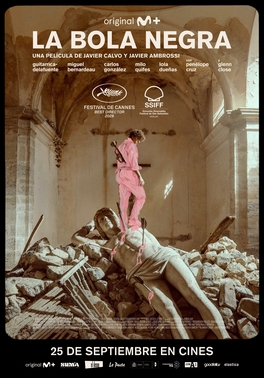
Explores what it means to be gay throughout different eras, focusing on “three existences” that are connected through themes of sexuality, desire, pain, and inheritance.
The critically acclaimed Spanish Civil War epic ‘La Bola Negra’ is an ambitious and beautifully constructed film that draws inspiration from the unfinished work of Federico García Lorca, as well as Alberto Conejero’s play ‘La piedra oscura’. Directed by Javier Ambrossi and Javier Calvo, collectively known as Los Javis, it tells three interconnected stories set in 1932, 1937 and 2017. The central story follows Sebastián (Guitarricadelafuente), a young soldier fighting for the Nationalists during the Civil War who develops a relationship with a Republican prisoner (Miguel Bernardeau). Elsewhere, a young man struggles with his sexuality in pre-war Spain, while in the present day a historian investigates a mysterious family inheritance. The connections between these three stories gradually become clear as the film explores the lives of gay men across different generations.
What impressed me most was the confidence with which the filmmakers bring these three narratives together. Each has its own distinct visual identity and initially feels like a separate story, but as the film progresses, the connections between them become clearer, with revelations that are both satisfying and emotionally rewarding. There’s an enormous amount of work involved in making a structure like this feel so coherent, particularly when the stories are separated by decades, but Los Javis handle the transitions brilliantly, gradually revealing information without making the film feel overly complicated. At almost three hours it’s a substantial undertaking, yet I never felt the running time, which is quite an achievement given how much ground the film covers.
The direction is outstanding throughout, with some really striking imagery and beautifully composed shots that give each of the three periods its own character. The cinematography is particularly impressive, while the performances are excellent across the board, particularly Guitarricadelafuente, the Spanish singer-songwriter making his acting debut, who brings a real sensitivity to Sebastián and his relationship with Bernardeau’s character. If I have a criticism, it’s that the story within the story, drawing more directly on Lorca’s fictional writing, is probably the least interesting of the three strands for me, particularly compared with the more grounded historical and contemporary narratives. Even so, I appreciated how it contributes to the wider themes of the film and the way the different sections eventually inform one another.
I really liked ‘La Bola Negra’, which is a hugely ambitious film about the way the past continues to reverberate through the present, particularly when the lives and experiences of people have been suppressed or forgotten. There’s plenty to unpack in its treatment of Spanish history, sexuality and artistic expression, and I suspect there’s a lot that would reward a second viewing. The way the three stories gradually come together is particularly satisfying, with some terrific revelations along the way, and I was hugely impressed by the confidence and skill involved in bringing it all together. It’s an excellent film, both in terms of its storytelling and the quality of the filmmaking.
Rating: 4/5
Directed By: Javier Calvo and Javier Ambrossi
Starring: Guitarricadelafuente, Miguel Bernardeau, Carlos González, Milo Quifes, Lola Dueñas, Penélope Cruz and Glenn Close

