
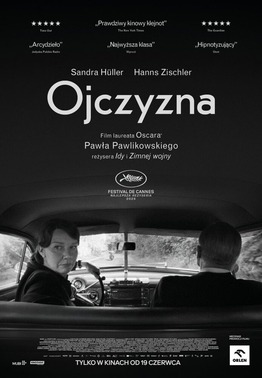
At the height of the Cold War, Fatherland centers on the relationship between the writer Thomas Mann and his daughter Erika—actress, writer and rally driver—as they embark on a road trip in a black Buick cruiser across a Germany in ruins.
The third and final film in Paweł Pawlikowski’s loose trilogy exploring different stories from postwar Europe, ‘Fatherland’ follows ‘Ida’ and ‘Cold War’ in both style and themes, and if you liked those films (as I did), I suspect you’ll find plenty to enjoy here too. Set in 1949, it follows Nobel Prize-winning German writer Thomas Mann (Hanns Zischler) as he returns to his homeland after 16 years in exile, accompanied by his daughter Erika (Sandra Hüller). The pair embark on a road trip across a country still coming to terms with the devastation of the Second World War, travelling from American-controlled Frankfurt to Soviet-controlled Weimar, with Germany’s future increasingly uncertain as the Cold War begins to take shape.
As with his previous films, Pawlikowski manages to pack an enormous amount into a relatively short running time, with plenty going on beneath what initially appears to be a fairly straightforward story. There’s a lot to unpack here, and I think a reasonable knowledge of the political settlements in postwar Europe is helpful in understanding some of the conversations and encounters along the way. The characters are still grappling with the horrors of the war, but there’s also a real cynicism about what the future might hold, with Germany divided between competing powers and little certainty that the mistakes of the past won’t be repeated. The relationship between Thomas and Erika is central to all of this, with their differing perspectives on the country they’ve returned to revealing some of the tensions within their own family.
The performances are superb, particularly Zischler and Hüller, who convey a great deal about their characters without needing to spell everything out. The black-and-white cinematography from Pawlikowski’s regular collaborator Łukasz Żal is equally impressive, with some beautiful compositions that capture both the physical damage left by the war and the uneasy atmosphere of a country trying to rebuild itself. Like ‘Ida’ and ‘Cold War’, it’s a film that often says as much through its images and silences as it does through the dialogue, and there’s a particularly moving final scene that brings together much of what Pawlikowski has been exploring in largely wordless fashion.
I really liked ‘Fatherland’, which is another excellent film from Pawlikowski and one that feels very much of a piece with his previous two. It’s a relatively small story, but there’s an awful lot going on within it, both in terms of the personal relationships and the wider questions about guilt, identity and what comes after a catastrophe on the scale of the Second World War. Not everything is immediately obvious, and I suspect there’s plenty I missed on a first viewing, but I found it thoroughly absorbing and was particularly impressed by how much Pawlikowski manages to convey in just 82 minutes.
Rating: 4/5
Directed By: Pawel Pawlikowski
Starring: Sandra Hüller, Hanns Zischler, August Diehl, Devid Striesow, Anna Madeley, David Menkin and Joachim Meyerhoff

