
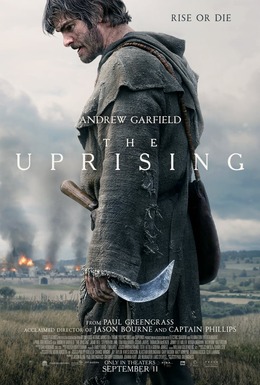
Based on the true story of the uprising that inspired the legend of Robin Hood, Andrew Garfield stars as the leader of a rebellion against the tyranny of King Richard II in a fight for justice.
The Peasants’ Revolt of 1381 is probably not an event that many people will be particularly familiar with, despite being one of the most significant uprisings in English history. It’s the subject of Paul Greengrass’s ‘The Uprising’, which tells the story of thousands of ordinary people rising up against the establishment during the reign of Richard II. With the country still suffering from the devastating effects of the Black Death, and the population being squeezed further by increasingly punitive taxation, resentment towards the king’s advisers reaches breaking point. Andrew Garfield plays a grieving farmer known only as Ploughman, whose actions help spark a wider rebellion, eventually joining forces with Wat Tyler (Cosmo Jarvis) and John Ball (Jamie Bell) as the peasants march on London to present their demands to the king.
It’s a bleak and often violent film, but I enjoyed Greengrass’s approach to the material, particularly the way he captures the growing anger of people who feel increasingly powerless and eventually reach the point where they believe they have no choice but to revolt. What’s particularly interesting is how that anger develops once the rebellion gathers momentum. The leaders initially have relatively clear demands and believe they can negotiate with the king, but having encouraged thousands of people to rise up against their rulers, they find it increasingly difficult to contain the violence and keep everyone focused on what they originally set out to achieve. It’s an interesting examination of how quickly a movement can take on a life of its own, and how difficult it can be to bring people back under control once they’ve been pushed to such extremes.
Greengrass brings his familiar energetic style to the film, with the handheld camerawork and chaotic action helping to convey the brutality of the period and the sheer scale of the unrest. Garfield is good as the central figure, while Jarvis and Bell are convincing as two very different leaders of the rebellion. There has been some criticism of the film’s historical liberties and its attempts to draw connections with the present day, but neither particularly bothered me. The parallels with modern events are fairly obvious, particularly around inequality, distrust of those in power and the consequences of encouraging public anger, but I think the film handles these ideas well enough without needing to make them too explicit.
Spoilers for the ending ahead….
The one element I wasn’t entirely convinced by was the epilogue, which makes a rather odd connection to the Robin Hood legend and feels somewhat out of place after what has otherwise been a largely bleak account of the revolt. It’s an unnecessary addition to a story that has more than enough to say on its own. That aside, I thought ‘The Uprising’ was a well-made and engaging historical drama, bringing to life a fascinating, and for me, unknown, period of English history while exploring ideas about power, inequality and rebellion that remain just as relevant today.
Rating: 3/5
Directed By: Paul Greengrass
Starring: Andrew Garfield, Jamie Bell, Stephen Dillane, Tom Hollander, Cosmo Jarvis, Thomasin McKenzie, Jonny Lee Miller, Woody Norman and Katherine Waterston

