
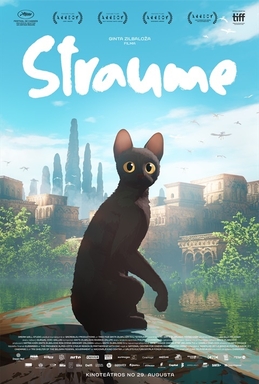
Cat is a solitary animal, but as its home is devastated by a great flood, he finds refuge on a boat populated by various species, and will have to team up with them despite their differences.
This year’s winner at the Oscars for Best Animated Feature has finally been released in UK cinemas and it has certainly been worth the wait as ‘Flow’ is a truly terrific and moving piece of cinema. The first Oscar winner to come from Latvia is directed by Gints Zilbalodis, and it follows the story of a dark grey cat in a post-apocalyptic flooded land as the cat and other animals try to survive in the rapidly changing conditions. It is devoid of dialogue and features no human characters, and unlike most movies that feature animals, the animals largely behave like animals and don’t take on human characteristics – and ‘Flow’ is all the better for it.
The production of ‘Flow’ is remarkable in itself, in that it was created entirely in Blender, a free and open source computer graphics software, and it gives the movie a distinctive look that isn’t like most animated movies being made today. The plot follows the unnamed cat as he is caught in a flood, eventually managing to jump into a sailboat with a capybara aboard. Alongside the capybara and several other animals they find along the way, they sail along through a land of rising water levels, observing both the danger and the wonder of their rapidly changing landscape. There are moments of great beauty and peril, which are blended alongside some imagery that are more surreal and on occasion, take on a spiritual dimension. I was gripped throughout all of it.
I saw another critic describe ‘Flow’ as brimming with sentiment and not sentimentality (Christian Blauvelt, for IndieWire), and I can’t think of a better description myself. ‘Flow’ is a deeply stirring and emotional animated movie that will have all but the most ardent non animal lovers in the palm of its hand, and after this and his debut feature ‘Away’, Zilbalodis is a talent well worth keeping an eye on.
Rating: 4/5
Directed By: Gints Zilbalodis
 'I am happy. You no die. Let's save planets!' Project Hail Mary (2026)
[…] 14. Flow (Straume) […]
LikeLike
[…] A Complete Unknown19. Weapons18. September 517. Companion16. Black Bag15. A Real Pain14. Flow (Straume)13. Sinners12. The Ballad of Wallis Island11. Young Mothers (Jeunes […]
LikeLike